Wednesday, August 23, 2006
Conferences
Later in the year I will be off to the ISBE conference, as are many of my colleagues. This annual national conference is the place for all things related to small business and entrepreneurship. All things being equal I will be presenting a paper on the pilot study of female entrepreneurs in the creative industries - which copyright dependent I will make available from this blog.

Friday, May 26, 2006
Creative Industires Women in business
Again another great stretch of time has passed since I last posted. This is something to do with spending the whole of April in New Zealand and Germany and taking a little longer than anticipated to get back into the swing of blogging - still enough excuses!
Although I have not been blogging I have been heavily involved in writing up some of the findings of recent research. As reasonably new to this whole research gig I can tell you that academic writing is hard (for me at least) and hugely time consuming this is mainly due to the amount of reading, understanding, salient point finding and then re-writing that is required. But I could go on and on about this - it is something I feel I am only really just getting the hang of and understanding the merit of the depth of literature review and rigour required.
More interestingly, perhaps, than my ponderings on writing are what I/we have been reporting on. One of the papers looks at some of the initial finding of a piece of research I've been involved in over the last twelve months which looks at female entrepreneurship in the creative industries. This has been for me a fascinating study into an area I have personal experience of and in some ways proved to back up all of the things I ever new about this sector, briefly these comprise of issues around friendship, networks, the night-time economy and fluid teams. Of course you'll have to wait for the paper to be published (if ever).
What was unexpected for me was how hard it proved to be to find the women. I was looking for women across the sector who were running established businesses (with employees and trading more than a year). This proved to be much harder than anticipated. Subsequent research has born out this initial revealing finding. Women are indeed under-represented in the sector in terms of business owners for example in Birmingham (UK) only 17% of businesses in the film and TV sub-sector are run by women. This is not to say this is the case across the country or sector but is certainly indicative of the situation I came across.
Anyway that is all for now just a little food for thought. Why are there so few women running businesses in the sector and does it matter?
Although I have not been blogging I have been heavily involved in writing up some of the findings of recent research. As reasonably new to this whole research gig I can tell you that academic writing is hard (for me at least) and hugely time consuming this is mainly due to the amount of reading, understanding, salient point finding and then re-writing that is required. But I could go on and on about this - it is something I feel I am only really just getting the hang of and understanding the merit of the depth of literature review and rigour required.
More interestingly, perhaps, than my ponderings on writing are what I/we have been reporting on. One of the papers looks at some of the initial finding of a piece of research I've been involved in over the last twelve months which looks at female entrepreneurship in the creative industries. This has been for me a fascinating study into an area I have personal experience of and in some ways proved to back up all of the things I ever new about this sector, briefly these comprise of issues around friendship, networks, the night-time economy and fluid teams. Of course you'll have to wait for the paper to be published (if ever).
What was unexpected for me was how hard it proved to be to find the women. I was looking for women across the sector who were running established businesses (with employees and trading more than a year). This proved to be much harder than anticipated. Subsequent research has born out this initial revealing finding. Women are indeed under-represented in the sector in terms of business owners for example in Birmingham (UK) only 17% of businesses in the film and TV sub-sector are run by women. This is not to say this is the case across the country or sector but is certainly indicative of the situation I came across.
Anyway that is all for now just a little food for thought. Why are there so few women running businesses in the sector and does it matter?
Friday, March 10, 2006
Yikes I'm on a roll
Not quite.
Just wanted to mention, briefly, another blog of mine that might be of interest to some of you.
Another project I am working on called Agender (an EQUAL ESF project) have positively encouraged the use of blogging as an ongoing part of the research process (part of a wider desire for complete transparency). I really welcome this approach as having worked on public funded research projects in the past I have always found the line between what is public, when does it become public and what is owned by the funders rather ambiguous.
This approach also offers me the opportunity to get feedback, provides an ongoing platform to share idea with other partners in the project and hopefully contributes to the wider learning of the partnership as we go rather than a just a weighty report at the end.
Anyway I'm in danger of ranting. The project itself is looking at non-traditional job roles e.g: women into construction, IT , software design and men into childcare - it's early days but do take a look Agender Blog.
Just wanted to mention, briefly, another blog of mine that might be of interest to some of you.
Another project I am working on called Agender (an EQUAL ESF project) have positively encouraged the use of blogging as an ongoing part of the research process (part of a wider desire for complete transparency). I really welcome this approach as having worked on public funded research projects in the past I have always found the line between what is public, when does it become public and what is owned by the funders rather ambiguous.
This approach also offers me the opportunity to get feedback, provides an ongoing platform to share idea with other partners in the project and hopefully contributes to the wider learning of the partnership as we go rather than a just a weighty report at the end.
Anyway I'm in danger of ranting. The project itself is looking at non-traditional job roles e.g: women into construction, IT , software design and men into childcare - it's early days but do take a look Agender Blog.
Tell me a story
Forgive me dear Blog reader but it has been over a month since my last posting. Not quite sure what happened, blogging fatigue maybe? I'm trying very hard to find my blogging mojo so in an attempt to break this negative cylce of low content production I'll just start writing and see what happens........
Maybe I'll tell you about some stories. In an earlier post I questioned my own creative output, being a researcher and all (hey I have a fine art degree it matters...ok). Well some useful responses courtesy, I belive, of Antonio Gould made me examine this whole thing a little bit more and reminded me that within research there is always the opportunity to take a creative approach, not to mention the endless writing that seems to accompany it.........not always so creative.
But here's the thing. Recently I have ben using a narrative methodology in my rsearch, in two ways both eliciting stories that people have been told and also having folks tell me their own experience as a story, this, in particular, I find extremely interesitng (it helps that I am genuinly interested in hearing about people - read nosey if you like). What I have discovered with this approach is that amongst other things it helps with the following things:
Maybe I'll tell you about some stories. In an earlier post I questioned my own creative output, being a researcher and all (hey I have a fine art degree it matters...ok). Well some useful responses courtesy, I belive, of Antonio Gould made me examine this whole thing a little bit more and reminded me that within research there is always the opportunity to take a creative approach, not to mention the endless writing that seems to accompany it.........not always so creative.
But here's the thing. Recently I have ben using a narrative methodology in my rsearch, in two ways both eliciting stories that people have been told and also having folks tell me their own experience as a story, this, in particular, I find extremely interesitng (it helps that I am genuinly interested in hearing about people - read nosey if you like). What I have discovered with this approach is that amongst other things it helps with the following things:
- Both you and the interviewee identify the most salient points through the story
- Everyone understands stories, so it is a nice common curreny between interviewer, interviee and future reader
- It helps you find out how an orgnaisation/individual has made sense of a situation
I recently spoke to a senior colleague who introduced me to this approcah, he also makes use of drawing and all mannor of other creative means to understand and explore human and organsiational experiences.To this end I will be attending some regular workshops to try to get my head around these other methodolgies and hopefully will be testing them out on some folks.
My next step is how to make the writing really interesting to read (and I don't mean this blog, I'm hoping the posts are short enough not to get too dull)....and to think about other methods of disseminating my research findings.
Thursday, February 02, 2006
Pictures and Surveys
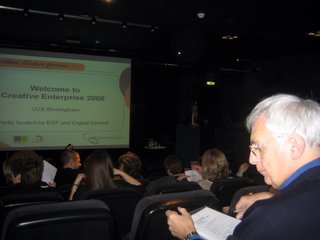
Here is one of the only reasonable pictures that I took at our event at the Custard factory last week. Unfortunatly none of them came out too well, but this gives a bit of a feel for the day. We have recently sent out a brief survey to all delegates to gauge current attitudes towards the creative enterprise agenda. This will be included in the final report which will be available via Media Content Lab's website soonish.
If you would like to contribute to this survey then please email responses to the following questions:
1. How would you describe your role within this field?
2. What is your attitude towards educating Creative Industry students in enterprise?
3. What could Higher Education be doing to better support Creative Industry students and graduate progression into self-employment and/or entrepreneurship?
4. How would you like to see the field of creative enterprise education progress?
5. What would be a useful tool to help you learn more about this field? (e.g. website, email discussion list, newsletter)
6. Would you be interested in attending a follow-up conference (2007) to explore and develop some of the themes relevant to this topic?
7. Do you have any comments relating to aspects not covered above?
If you would like to contribute to this survey then please email responses to the following questions:
1. How would you describe your role within this field?
2. What is your attitude towards educating Creative Industry students in enterprise?
3. What could Higher Education be doing to better support Creative Industry students and graduate progression into self-employment and/or entrepreneurship?
4. How would you like to see the field of creative enterprise education progress?
5. What would be a useful tool to help you learn more about this field? (e.g. website, email discussion list, newsletter)
6. Would you be interested in attending a follow-up conference (2007) to explore and develop some of the themes relevant to this topic?
7. Do you have any comments relating to aspects not covered above?

Thursday, January 26, 2006
Creative Entrepreneurs from Creative Students
Well it's the day after what proved to be a pretty successful event. Antonio Gould one of our panellists and Director of 3form a local Internet company has posted this very positive account of the day on his newish blog. Overall I found the occasion very positive with some clear next steps for how as a community of interest we might all start working together i,e those folks with an interest in educating creatives in enterprise. For me there was a whole host of new ideas that came out of the event and really by way of reminding myself here is a bullet list of future posts I will attempt to write from things that came up from the day:
1. Do creative people learn differently? Or is just that they are taught differently?
2. What can Business Schools learn from Arts Schools in terms of experiential learning for future entrepreneurs: i.e brief, self management, critique
3. With the increasing lack of failure in HE (i.e no one fails anything anymore) is being a student detrimental to developing your enterprising abilities. (i.e failure, coping with failure/rejection is part and parcel of the real world for creative Industries).
There are many more but I will try to get back to these soon. There will also be a longer and more comprehensive breakdown of the conference coming soon/tomorrow.
1. Do creative people learn differently? Or is just that they are taught differently?
2. What can Business Schools learn from Arts Schools in terms of experiential learning for future entrepreneurs: i.e brief, self management, critique
3. With the increasing lack of failure in HE (i.e no one fails anything anymore) is being a student detrimental to developing your enterprising abilities. (i.e failure, coping with failure/rejection is part and parcel of the real world for creative Industries).
There are many more but I will try to get back to these soon. There will also be a longer and more comprehensive breakdown of the conference coming soon/tomorrow.
Sunday, January 22, 2006
Are creative people entrepreneurs? 1st attempt
Here I am making a brief examination of how the four or was it five? aforementioned characteristics of entrepreneurship fit with the profile of creative industries people.
Entrepreneurs are prepared to take risks
This got me thinking. Are all folks that go through creative industry type courses* entrepreneurs? Based on the highly competitive fields that we are training people for aren't those creative individuals taking a risk on their own talent, future employment, financial and not to mention emotional well-being (i.e if it doesn't work out and it doesn't always). Do they make an investment in their talent and hope it pays dividends?
The Entrepreneur manages resources, knowledge and power (as opposed to being an employee and having those things managed by other people)
Levels of self-employment within the creative sector are very high. In some sectors as many as 80%* of individuals are self-employed. With over 42%* of creative industry graduates having had some level of self-employment in the first five years of graduating.
Doesn't sound like employee material to me ..although note to self :- must remember to ask esteemed colleague about entrepreneurship through necessity, survival...When that is the only employment option!
They are in pursuit of profit (although this may come in the form of something other than money) but lead us to question how do we measure 'other' types of profit?
Now this is a strange one, you see and this is anecdotal, from my own experience and backed up by a series of recent interviews. The motivations for people within these sectors are often around full-filling a creative need, not being an employee, not selling out or giving up, doing a better design, building a bigger profile, being 'known' for being good at what they do. The motivation is never cited as being financial although all recognise that this is a requirement of staying in business and continuing to do what they want to do. In terms of this profiting them I need to think about this one.
Personal satisfaction is a major motivator
As above - this is a major motivational factor in this sector and a major reason for folks pursuing the self-employment route.
Their relationship to opportunity: they tend to either seek it, create it or recognise it and presumably exploit it!
In a recent piece of research I was involved in, that looked at social inclusion in the creative industries, one of the major barriers to beneficiaries (individuals who took part in the project) becoming or sustaining self-employment was there inability to do any of the above, sometimes these were the most talented individuals but there inability to exploit, recognise, or pursue opportunities set them apart from others. There maybe many reasons for this but what it did identify was that in this sector where talent is at such a high premium without the opportunity its not worth having. Incidentally the groups who were targeted for that piece of research were from communities who were vastly under-represented in the creative industries and had even lower levels of self-employment.
* I will dig out the references for these stats, mainly from the Destinations and Reflections report (1999)
Entrepreneurs are prepared to take risks
This got me thinking. Are all folks that go through creative industry type courses* entrepreneurs? Based on the highly competitive fields that we are training people for aren't those creative individuals taking a risk on their own talent, future employment, financial and not to mention emotional well-being (i.e if it doesn't work out and it doesn't always). Do they make an investment in their talent and hope it pays dividends?
The Entrepreneur manages resources, knowledge and power (as opposed to being an employee and having those things managed by other people)
Levels of self-employment within the creative sector are very high. In some sectors as many as 80%* of individuals are self-employed. With over 42%* of creative industry graduates having had some level of self-employment in the first five years of graduating.
Doesn't sound like employee material to me ..although note to self :- must remember to ask esteemed colleague about entrepreneurship through necessity, survival...When that is the only employment option!
They are in pursuit of profit (although this may come in the form of something other than money) but lead us to question how do we measure 'other' types of profit?
Now this is a strange one, you see and this is anecdotal, from my own experience and backed up by a series of recent interviews. The motivations for people within these sectors are often around full-filling a creative need, not being an employee, not selling out or giving up, doing a better design, building a bigger profile, being 'known' for being good at what they do. The motivation is never cited as being financial although all recognise that this is a requirement of staying in business and continuing to do what they want to do. In terms of this profiting them I need to think about this one.
Personal satisfaction is a major motivator
As above - this is a major motivational factor in this sector and a major reason for folks pursuing the self-employment route.
Their relationship to opportunity: they tend to either seek it, create it or recognise it and presumably exploit it!
In a recent piece of research I was involved in, that looked at social inclusion in the creative industries, one of the major barriers to beneficiaries (individuals who took part in the project) becoming or sustaining self-employment was there inability to do any of the above, sometimes these were the most talented individuals but there inability to exploit, recognise, or pursue opportunities set them apart from others. There maybe many reasons for this but what it did identify was that in this sector where talent is at such a high premium without the opportunity its not worth having. Incidentally the groups who were targeted for that piece of research were from communities who were vastly under-represented in the creative industries and had even lower levels of self-employment.
* I will dig out the references for these stats, mainly from the Destinations and Reflections report (1999)
Friday, January 20, 2006
5 days to go!
Ladies and Gentlemen there are now just 5 days until the Creative enterprise event I and some colleagues from our faculty of Art and Design are organising. I will be feeding back shortly afterwards, We have had an overwhelming response from potential delegates and have filled (if they all turn up) each of the Custard Factory theatres seats and a reserve list of 20! This will be a busy day and very timely with the recent publishing of the Cox Review which will undoubtedly get some airplay next Wednesday. This review is definitly worth a read, especially as the role of higher education in promoting creativity and enterprise is heavily featured.
Wednesday, January 18, 2006
Questions answered? sort of
The other evening, following a long day at work, I and some fellow colleagues trundled down the corridors and passageways of our building to attend a workshop lead by our esteemed colleague and widely acknowledged expert on the subject of Enterprise and Entrepreneurship, Dr Harry Matlay, Professor of Small Business and Enterprise Development. What followed proved to be a highly entertaining and even a little challenging dipping of the toes into the often complex world of entrepreneurship theory (?)
In this post I will just cover the event, as I saw it (I would like to say for the record that this is my interpretation and the messages I took from it), what happened etc and in a later post I hope to apply some of the stuff that was spoken about and hazard some observations as to how it fits with the Creative Industries sector.
The event was aptly named 'What is Entrepreneurship?' couldn't have come at a better time for me (see earlier post 'entrepre-what?' post) as this has been a question arising again and again since I got involved in this whole creative enterprise gig.
So here's where we got to, it's worth saying that, and Harry eluded to this, that we were somewhat covering the basics and like so many things with every answer came more questions, the answers of which are apparently being saved for a future event.
This was very much a participatory event and throughout we were asked to question our perceptions of what constitutes an entrepreneur:
Is Entrepreneurship about: Risk, state of mind, profit?
Harry went on to describe some 'Rules' of entrepreneurship at all times questioning our understanding against his and acknowledging that there are many opposing views as to what entrepreneurial traits are. But apparently entrepreneurs amongst other things tend to exhibit the following:
- Entrepreneurs are prepared to take risks
- The Entrepreneur manages resources, knowledge and power (as opposed to being an employee and having those things managed by other people)
- They are in pursuit of profit (although this may come in the form of something other than money and lead us to question how do we measure 'other' types of profit? – a point I will be re-visiting)
- Personal satisfaction is a major motivator
- Their relationship to opportunity: they tend to either: seek it, create it or recognise it and presumably exploit it
With a lively audience there was plenty of debate and disagreement around each of these issues and plenty of food for thought for me about the relationship between these attributes and folks from our sector. Accompanying this workshop was a thoroughly researched, well written and apparently award winning paper by Dr Matlay entitled: Researching entrepreneurship and education Part 1: what is entrepreneurship and does it matter? This paper offered up many more potential posts for this blog so watch this space!
In this post I will just cover the event, as I saw it (I would like to say for the record that this is my interpretation and the messages I took from it), what happened etc and in a later post I hope to apply some of the stuff that was spoken about and hazard some observations as to how it fits with the Creative Industries sector.
The event was aptly named 'What is Entrepreneurship?' couldn't have come at a better time for me (see earlier post 'entrepre-what?' post) as this has been a question arising again and again since I got involved in this whole creative enterprise gig.
So here's where we got to, it's worth saying that, and Harry eluded to this, that we were somewhat covering the basics and like so many things with every answer came more questions, the answers of which are apparently being saved for a future event.
This was very much a participatory event and throughout we were asked to question our perceptions of what constitutes an entrepreneur:
Is Entrepreneurship about: Risk, state of mind, profit?
Harry went on to describe some 'Rules' of entrepreneurship at all times questioning our understanding against his and acknowledging that there are many opposing views as to what entrepreneurial traits are. But apparently entrepreneurs amongst other things tend to exhibit the following:
- Entrepreneurs are prepared to take risks
- The Entrepreneur manages resources, knowledge and power (as opposed to being an employee and having those things managed by other people)
- They are in pursuit of profit (although this may come in the form of something other than money and lead us to question how do we measure 'other' types of profit? – a point I will be re-visiting)
- Personal satisfaction is a major motivator
- Their relationship to opportunity: they tend to either: seek it, create it or recognise it and presumably exploit it
With a lively audience there was plenty of debate and disagreement around each of these issues and plenty of food for thought for me about the relationship between these attributes and folks from our sector. Accompanying this workshop was a thoroughly researched, well written and apparently award winning paper by Dr Matlay entitled: Researching entrepreneurship and education Part 1: what is entrepreneurship and does it matter? This paper offered up many more potential posts for this blog so watch this space!
Thursday, December 29, 2005
New Year
Happy New Year etc and for me some new years resoloutions:
1. Phd - get started
2. keep on blogging
3. Network - make connections get the whole 'linked in' thing working for me properly
1. Phd - get started
2. keep on blogging
3. Network - make connections get the whole 'linked in' thing working for me properly
Wednesday, December 21, 2005
Entre pre what?
Okay so last week at a rather stimulating 'away day' with the team, we touched on, but didn't get too involved in, the definition of an Entrepreneur. Over the last couple of months I've attended several conferences were the words 'enterprise' 'entrepreneurship' 'freelancer' 'self-employed' and 'business owner' seem to have been used interchangeably. So anyway this day I guess I was doing that same such thing in relation to the creative industries (two other heavily used words) and my esteemed colleague (prof) was quick to point out my inappropriate use of the word entrepreneur. Based on this I have decided I need to apply some rigour to my use of language, but here is where I was coming from.
Firstly here is my original home spun version of what I had always considered an entrepreneur.
It all started with when I was about 12 and my dad described Arthur Daley (Minder, Thames Television) as an 'entrepreneur' he, my dad, described an entrepreneur as someone who sought and exploited opportunities in order to make money (or something like that) the general vibe was someone who was an opportunist, motivated ostensibly by making a reasonably speedy return on their investment (usually from a lock-up in south London).
As I got older I started to think of entrepreneurship as something pretty seedy, this was the 80's after all and my naive left wing, art school trained views lead me to distrust the commercial world and the money crabbing greedy 'entrepreneurs' I perceived as benefiting from Thatcherite Britain...where am I going with this?
Anyway it took me a long time to get over this view, some how as an artist if you did 'commercial' work you had some how sold out. But hang on. As an artist I did pretty quickly get into the commercial world after all I had ideas and opportunities that I needed to exploit, that were timely, that might just serve to raise my profile or might serve any number of 'other' purposes. But was this activity entrepreneurial? When a student leaves art, design, drama, music college and they find they have to work as a freelancer do they not need to exhibit entrepreneurial traits? seeking and exploiting opportunities in order to succeed in a crowded and competitive market?
Well this is all fair and good but it's just me expressing some thoughts and opinions and in the academic world that isn't sufficient. There are definitions, whole strands of academic scholarship devoted to the subject and here I will try and bring to you some of those definitions and ideas as I discover them. You might also wonder whether or not the definitions are important. I am suspending judgement until I find out a little more but my main focus for this is to questions whether or not individuals working in the creative industries, whether they be self-employed, just freelancers or running small companies are actually entrepreneurs?
Firstly here is my original home spun version of what I had always considered an entrepreneur.
It all started with when I was about 12 and my dad described Arthur Daley (Minder, Thames Television) as an 'entrepreneur' he, my dad, described an entrepreneur as someone who sought and exploited opportunities in order to make money (or something like that) the general vibe was someone who was an opportunist, motivated ostensibly by making a reasonably speedy return on their investment (usually from a lock-up in south London).
As I got older I started to think of entrepreneurship as something pretty seedy, this was the 80's after all and my naive left wing, art school trained views lead me to distrust the commercial world and the money crabbing greedy 'entrepreneurs' I perceived as benefiting from Thatcherite Britain...where am I going with this?
Anyway it took me a long time to get over this view, some how as an artist if you did 'commercial' work you had some how sold out. But hang on. As an artist I did pretty quickly get into the commercial world after all I had ideas and opportunities that I needed to exploit, that were timely, that might just serve to raise my profile or might serve any number of 'other' purposes. But was this activity entrepreneurial? When a student leaves art, design, drama, music college and they find they have to work as a freelancer do they not need to exhibit entrepreneurial traits? seeking and exploiting opportunities in order to succeed in a crowded and competitive market?
Well this is all fair and good but it's just me expressing some thoughts and opinions and in the academic world that isn't sufficient. There are definitions, whole strands of academic scholarship devoted to the subject and here I will try and bring to you some of those definitions and ideas as I discover them. You might also wonder whether or not the definitions are important. I am suspending judgement until I find out a little more but my main focus for this is to questions whether or not individuals working in the creative industries, whether they be self-employed, just freelancers or running small companies are actually entrepreneurs?
Technorati Tags: Creativity, Enterprise,
Education,
Entrepreneurship,
Internet,
Creative Industries, Business,
Saturday, December 17, 2005
Mini Conference
I spend a day a week seconded to our Faculty of Art and Design, as well as working the research strand of their new media enterprise MA I am helping them to organise an event looking at Enterprise curriculum in Higher Education for Creative Industries. I've been responsible for generating the content of the day and so far it's looking pretty interesting. Rather than duplicate it all take a look at Media Content labs website, this is the department with in the faculty running this course. It's also quite a unique collaboration between the business school and Art School, quite appropriate for something looking at Creative Enterprise. I'll keep you all posted as this develops. For your diary it's 25th January 2006 in Birmingham UK
Technorati Tags: Creativity, Event, Art, Curriculum, Enterprise,
Monday, December 12, 2005
I have a hunch...
Now I know I've mentioned this before but what started as a vague hunch is transforming into an idea or an opinion at least. Okay so first of all let me set the scene it's Wolverhampton 1991-1994, School of Art and Design 7th floor, (the school of fine art) off a long corridor there are light and airy (often cold in winter) rooms (I will refer to them as studios) in each studio there are between 1 and 6 students sometimes the studio is full, sometimes empty. Each student has their own space, their studio space.
Unlike most students these are not governed by a rigid timetable of lectures, essay deadlines and workshops. Instead they are given briefs to work to, often devised through negotiation with their lecturer (client) and then they are left to get on with it. Although the lecturer will appear from time to time over the coming weeks/months the student will only get to see him/her if they schedule an appointment (meeting). But for the most part they will get on with their work, will require self-discipline and motivation and will often seek the support of their fellow students(colleagues, networks)to bounce ideas around and brain storm.
At an agreed time the groups of students will present their work for critique, they will be required to present to a group of fellow students and lecturer (colleagues and clients) and be prepared to defend the rigor of their work. They may also be required to find an external avenue for presenting this work (a gallery space), requiring negotiating with external groups and orgnaisations.
Okay so what's my point? Well this is a brief outline of the type of education I experienced. And experience is the right word, the transition from Art school to the real world, although painful in some ways was quite straight forward. Well what did I need? Oh yes a studio space (check), some clients (check), some self-discipline and motivation(Check, check). My point is that this sort of experiential learning is not so far removed from the idea of an incubation unit.
The Creative Industries have very high levels of self-employment and endeavours, based on this model, I wonder, is it that suprising?
Unlike most students these are not governed by a rigid timetable of lectures, essay deadlines and workshops. Instead they are given briefs to work to, often devised through negotiation with their lecturer (client) and then they are left to get on with it. Although the lecturer will appear from time to time over the coming weeks/months the student will only get to see him/her if they schedule an appointment (meeting). But for the most part they will get on with their work, will require self-discipline and motivation and will often seek the support of their fellow students(colleagues, networks)to bounce ideas around and brain storm.
At an agreed time the groups of students will present their work for critique, they will be required to present to a group of fellow students and lecturer (colleagues and clients) and be prepared to defend the rigor of their work. They may also be required to find an external avenue for presenting this work (a gallery space), requiring negotiating with external groups and orgnaisations.
Okay so what's my point? Well this is a brief outline of the type of education I experienced. And experience is the right word, the transition from Art school to the real world, although painful in some ways was quite straight forward. Well what did I need? Oh yes a studio space (check), some clients (check), some self-discipline and motivation(Check, check). My point is that this sort of experiential learning is not so far removed from the idea of an incubation unit.
The Creative Industries have very high levels of self-employment and endeavours, based on this model, I wonder, is it that suprising?
Monday, December 05, 2005
What is the role of blogging in research?
Following on from my previous post I am trying to get a consensus of some sort as to what the role of blogging is within research. With Creative enterprise I intend to gradually create a place for ideas and gradually build links with others, encourage others to comment and contribute and in so doing contribute to my research. But how does this fit with the regular research process?
Okay in my reasonably limited experience there seems to be quite a lot of secrecy around people's research, with embargoes on findings and obsessions with ownership until the last piece of analysis is complete. Now I know that this is often stipulated by funding bodies, but for someone who worked in internet companies and always talked about the virtues of open source and open philosophies to content distribution the whole embargo thing seems counter intuitive.
I'm not suggesting that one has all raw data online but a certain openness with issues that arise etc.. could offer opportunities.
Maybe I'm missing something?
Okay in my reasonably limited experience there seems to be quite a lot of secrecy around people's research, with embargoes on findings and obsessions with ownership until the last piece of analysis is complete. Now I know that this is often stipulated by funding bodies, but for someone who worked in internet companies and always talked about the virtues of open source and open philosophies to content distribution the whole embargo thing seems counter intuitive.
I'm not suggesting that one has all raw data online but a certain openness with issues that arise etc.. could offer opportunities.
Maybe I'm missing something?
In need of focus
This might be a bit off topic - but I have some concerns that arose today:
As someone who is relativly new to this academic gig I am just getting used to the way things are done. The type of research I'm involved in seems, often, like reportage.... let me explain.... a colleague and I were talking about this today. I identified a feeling I've had while involved in this work with the creative industries it often goes something like this:
'I used to be someone who created stuff and now I am someone who reports on other people creating stuff'
A part from seeming somewhat depressing, I wanted to get to something else, I mean research in other fields is often about innovation, discovering things and creating things. So my question to myself is:
'how am I innovating? what am I creating?'
As someone who is relativly new to this academic gig I am just getting used to the way things are done. The type of research I'm involved in seems, often, like reportage.... let me explain.... a colleague and I were talking about this today. I identified a feeling I've had while involved in this work with the creative industries it often goes something like this:
'I used to be someone who created stuff and now I am someone who reports on other people creating stuff'
A part from seeming somewhat depressing, I wanted to get to something else, I mean research in other fields is often about innovation, discovering things and creating things. So my question to myself is:
'how am I innovating? what am I creating?'
Subscribe to:
Posts (Atom)